Introduction
Artificial Intelligence (AI) has become one of the most transformative technologies of the 21st century. From powering recommendation systems on streaming platforms to enabling self-driving vehicles and intelligent virtual assistants, AI has reshaped how we interact with technology. Among the many advancements in this field, Generative Artificial Intelligence (Generative AI or Gen AI) stands out as one of the most revolutionary innovations.
Generative AI has captured global attention because it can create original content rather than simply analyzing existing data. It can write articles, generate realistic images, compose music, develop software, create videos, summarize documents, and even assist in scientific research. Businesses, educational institutions, healthcare organizations, and governments are rapidly integrating Generative AI into their daily operations to improve efficiency, reduce costs, and unlock new opportunities.
Unlike traditional AI systems that focus on recognizing patterns and making predictions, Generative AI produces entirely new outputs based on the information it has learned. This capability is transforming industries and redefining creativity in ways that were unimaginable just a few years ago.
This comprehensive guide explores everything you need to know about Generative AI, including its history, working principles, applications, benefits, challenges, ethical concerns, future trends, and practical use cases.
Understanding Generative AI
Generative AI is a category of artificial intelligence designed to generate new content that resembles human-created work. It learns from vast datasets containing text, images, videos, code, audio, and other digital information to produce meaningful and creative outputs.
Instead of merely retrieving existing information, Generative AI understands context, patterns, and relationships within data to create something entirely new.
For example, when asked to:
"Write a professional blog about cloud computing."
The AI doesn't search for an existing blog and copy it. Instead, it generates an original article based on its understanding of cloud computing concepts, writing styles, grammar, and context.
Similarly, if given the prompt:
"Create a futuristic city at sunset."
An AI image model can generate a completely unique digital artwork without copying an existing image.
Evolution of Artificial Intelligence
To understand Generative AI, it is helpful to look at the evolution of AI itself.
Rule-Based Systems
The earliest AI systems relied on manually programmed rules. These systems could only perform tasks for which explicit instructions had been written.
Example:
IF temperature > 35°C THEN turn on the fan.
These systems lacked learning capabilities.
Machine Learning
Machine Learning introduced algorithms capable of learning from data instead of relying solely on predefined rules.
Applications included:
Spam email detection
Fraud detection
Product recommendations
Sales forecasting
However, these systems mainly focused on prediction rather than creation.
Deep Learning
Deep Learning brought neural networks capable of processing enormous amounts of information.
This advancement enabled:
Speech recognition
Image recognition
Natural language processing
Autonomous vehicles
Deep learning laid the foundation for Generative AI.
Generative AI Era
Modern AI models now generate:
Text
Images
Videos
Code
Music
Voice
Presentations
3D Models
This marks the beginning of a new era where AI acts as a creative collaborator rather than just an analytical tool.
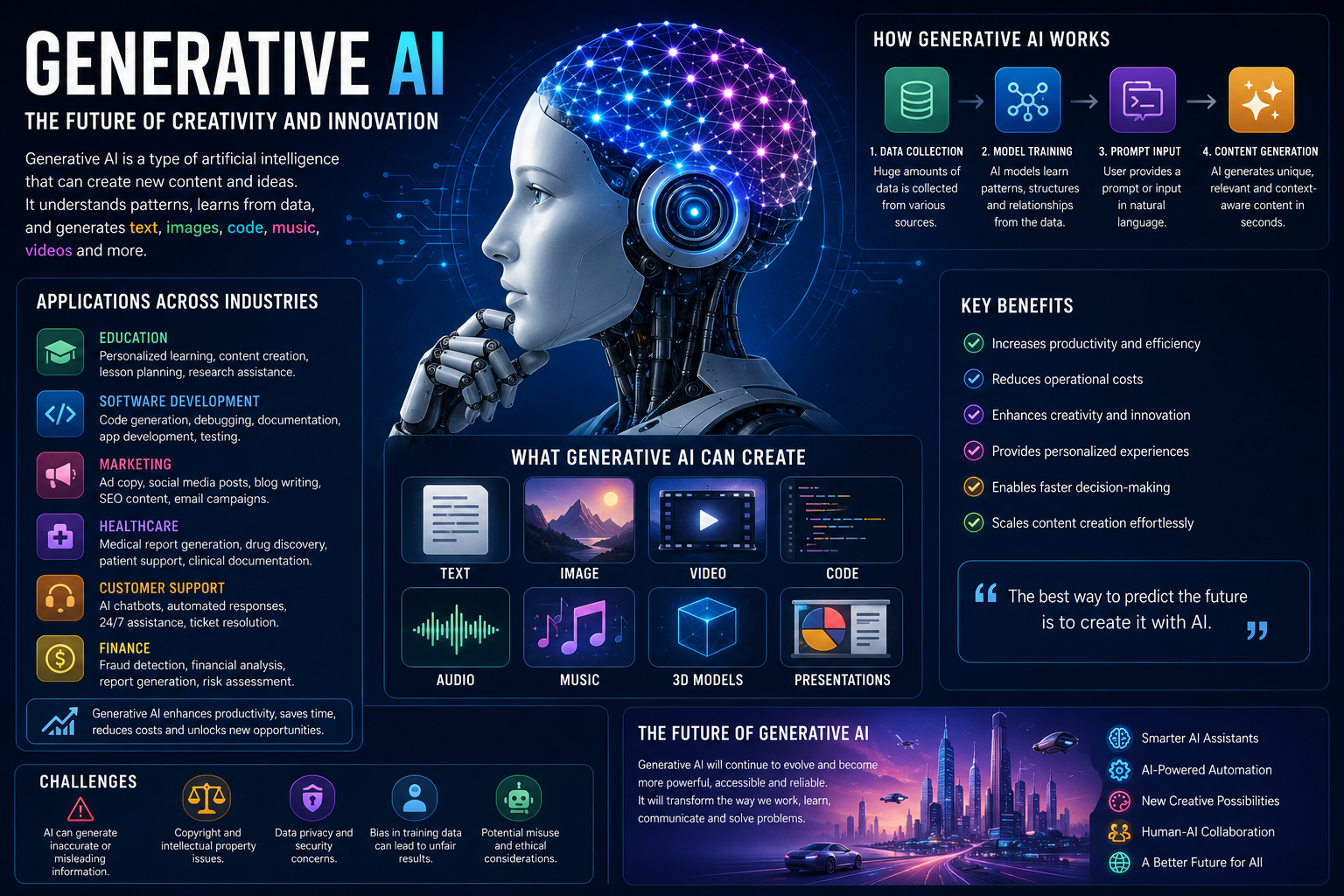
How Generative AI Works
Although Generative AI appears almost magical, it follows a structured learning process.
Step 1: Data Collection
AI models are trained using massive datasets gathered from publicly available sources such as:
Books
Websites
Scientific papers
Programming repositories
Articles
Images
Audio recordings
Videos
The larger and more diverse the dataset, the better the AI understands language and concepts.
Step 2: Training the Model
The collected data is processed using deep neural networks.
During training, the model learns:
Grammar
Vocabulary
Context
Logic
Relationships between concepts
Writing styles
Coding syntax
Visual structures
Training modern AI models requires thousands of GPUs and millions of dollars in computing resources.
Step 3: Prompt Processing
When users submit a prompt, the AI analyzes:
User intent
Context
Keywords
Tone
Required output
Language
This understanding helps generate relevant responses.
Step 4: Content Generation
The AI predicts one token (word or part of a word) at a time until the complete response is generated.
This prediction happens in milliseconds, allowing AI to produce long articles, software code, or creative stories almost instantly.
Types of Generative AI Models
Text Generation Models
These models specialize in natural language generation.
Capabilities include:
Blog writing
Emails
Reports
Documentation
Storytelling
Translation
Summarization
Image Generation Models
Image models convert text descriptions into visuals.
Applications:
Graphic design
Marketing
Advertising
Book covers
Concept art
Product visualization
Video Generation Models
AI now creates realistic videos from text prompts.
Businesses use them for:
Product advertisements
Explainer videos
Educational lessons
Social media content
Audio Generation Models
These systems generate:
Music
Voiceovers
Podcasts
Audiobooks
Sound effects
Code Generation Models
Software developers increasingly rely on AI to:
Generate code
Debug applications
Explain algorithms
Create APIs
Write documentation
Automate repetitive programming tasks
Key Technologies Behind Generative AI
Several advanced technologies power Generative AI systems.
Natural Language Processing (NLP)
Allows AI to understand and generate human language.
Deep Learning
Uses artificial neural networks that mimic how the human brain processes information.
Transformer Architecture
Transformers revolutionized AI by enabling models to understand long contexts efficiently.
Most modern AI systems rely on transformer-based architectures.
Large Language Models (LLMs)
Large Language Models are trained on trillions of words, enabling them to answer questions, write content, translate languages, and assist with programming.
Applications of Generative AI
Generative AI is impacting nearly every sector.
Education
Students use AI to:
Learn new subjects
Solve mathematical problems
Generate study notes
Prepare assignments
Practice coding
Improve writing skills
Teachers use AI for:
Lesson planning
Quiz creation
Personalized learning materials
Assessment generation
Software Development
Developers leverage AI to:
Write cleaner code
Debug faster
Generate APIs
Create documentation
Optimize algorithms
Automate testing
AI significantly reduces development time.
Healthcare
Medical professionals use AI for:
Clinical documentation
Medical image analysis
Drug discovery
Patient communication
Treatment recommendations
Administrative automation
Marketing
Marketing teams generate:
Blog articles
Product descriptions
Ad copy
Email campaigns
SEO content
Social media captions
This enables businesses to publish high-quality content at scale.
Customer Support
AI-powered chatbots now provide:
Instant responses
24/7 customer service
Ticket automation
Personalized assistance
Finance
Banks use AI for:
Fraud detection
Risk analysis
Financial reporting
Customer support
Investment insights
Human Resources
Recruitment teams automate:
Resume screening
Interview questions
Job descriptions
Employee onboarding
Manufacturing
Factories use AI for:
Predictive maintenance
Quality inspection
Production planning
Inventory management
Advantages of Generative AI
Increased Productivity
Tasks that once required several hours now take only minutes.
Cost Savings
Automation reduces labor costs while increasing operational efficiency.
Improved Creativity
AI provides fresh ideas that inspire designers, writers, marketers, and developers.
Faster Decision-Making
Businesses can analyze large volumes of information quickly.
Better Customer Experience
AI enables personalized recommendations and instant customer support.
Scalability
Organizations can generate thousands of pieces of content without significantly increasing resources.
Challenges of Generative AI
Despite its many benefits, Generative AI also presents challenges.
Hallucinations
AI can sometimes produce incorrect or fabricated information.
Fact-checking remains essential.
Copyright Concerns
Questions continue regarding ownership of AI-generated content and the use of copyrighted training data.
Data Privacy
Users should avoid sharing confidential information with AI systems unless they understand the platform's privacy policies.
Bias
AI models may inherit biases present in their training data, leading to unfair or inaccurate outputs.
Security Risks
Cybercriminals may misuse AI to generate phishing emails, fake identities, or malicious code, highlighting the need for responsible governance.
Prompt Engineering
Prompt engineering is the skill of writing effective instructions for AI.
A strong prompt includes:
Objective
Context
Desired format
Tone
Audience
Length
Constraints
Weak Prompt
Write about AI.
Strong Prompt
Write a 2,000-word SEO-optimized blog on Generative AI for beginners. Include headings, real-world examples, FAQs, and a conclusion using simple English.
The quality of the output often depends on the quality of the prompt.
Generative AI Across Industries
Generative AI is transforming:
Education
Healthcare
Banking
Retail
Manufacturing
Entertainment
Real Estate
Software Development
Agriculture
Legal Services
Research
Government
Media
Transportation
E-commerce
Almost every industry is exploring AI-driven innovation.
The Future of Generative AI
Experts believe the next generation of AI will be even more capable.
Future developments may include:
Autonomous AI agents
AI-powered software companies
Personalized digital assistants
AI doctors
AI tutors
AI lawyers
Real-time language translation
Intelligent robotics
Hyper-personalized education
Scientific research acceleration
Generative AI will likely become as common as the internet and smartphones are today.
Best Practices for Using Generative AI
To maximize value while minimizing risks:
Write clear and specific prompts.
Verify factual information from trusted sources.
Avoid sharing confidential or sensitive data.
Use AI to enhance—not replace—human expertise.
Stay informed about ethical guidelines and legal considerations.
Continuously experiment with prompts to improve results.
Frequently Asked Questions (FAQs)
Is Generative AI the same as Artificial Intelligence?
No. Generative AI is a specialized branch of Artificial Intelligence focused on creating new content, while AI encompasses many other technologies such as prediction, classification, robotics, and decision-making.
Can Generative AI replace humans?
Generative AI is designed to augment human capabilities rather than replace them entirely. It automates repetitive tasks, but human creativity, critical thinking, ethics, and decision-making remain essential.
Which industries benefit the most from Generative AI?
Technology, healthcare, education, finance, marketing, manufacturing, entertainment, legal services, and e-commerce are among the industries seeing significant benefits.
Is Generative AI safe to use?
Yes, when used responsibly. Users should verify important information, protect sensitive data, and follow ethical and legal guidelines.
Conclusion
Generative AI is reshaping the future of technology by enabling machines to create, innovate, and collaborate with humans in unprecedented ways. From writing articles and generating software code to designing artwork and accelerating scientific research, its applications are vast and continue to grow.
As organizations adopt AI-driven workflows, professionals who understand how to use Generative AI effectively will gain a significant advantage in the modern workplace. However, success with AI requires more than just access to powerful tools—it demands responsible use, critical thinking, and a commitment to continuous learning.
The future is not about humans competing with artificial intelligence; it is about humans and AI working together to solve complex problems, unlock creativity, and build a smarter, more innovative world. Those who embrace Generative AI today will be better prepared to lead, create, and thrive in the digital economy of tomorrow.